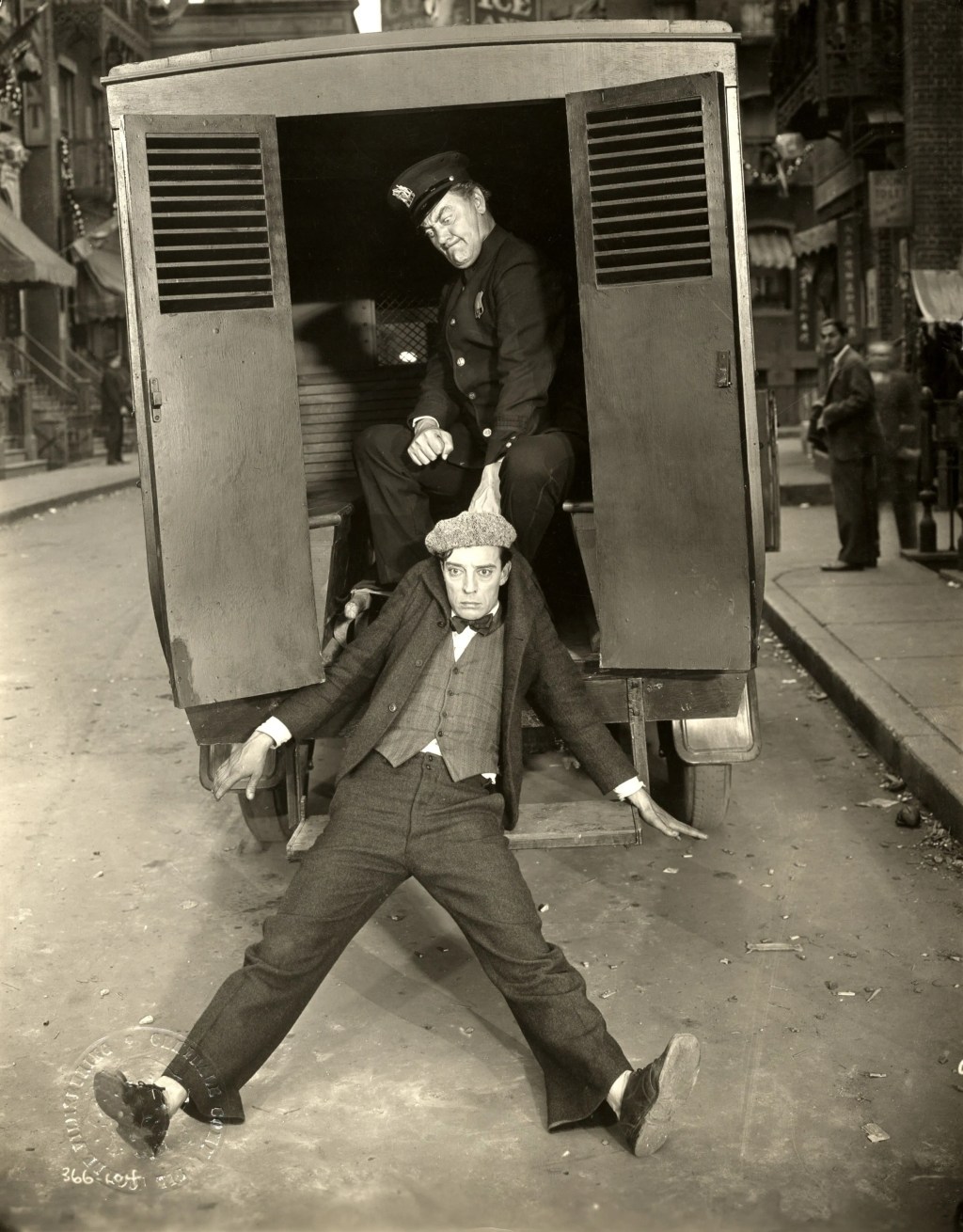
It’s unknown what the construction worker told James Mason when he discovered the false wall in the tool shed on the edge of the property. Behind the wall was a safe that was in rough enough shape that it was cracked by a locksmith without too much difficulty. The small safe was filled with nitrate film canisters. They were each labelled: The Navigator. Sherlock Jr. The General, among others. If the contractor didn’t know what they were, Mason did.
Mason knew the man who built his home was silent film comedian Buster Keaton. It was a sprawling Italian style villa on a hill, with tiers of steps lined with planters and tall narrow evergreens. At the bottom of the stairs was a pool that sat above the rolling green pastures of Beverly Hills. Buster sold the property back in the 1930s when his time as a star had waned to the point that the upkeep became too expensive. It broke Buster’s heart to sell that home. He built it from the ground up with the money he earned creating some of the most innovative comedies ever put on film.
It’s said that several famous actors and actresses rented the house over the years. Marlene Dietrich lived there with French actor Jean Gabin, Cary Grant and Randolph Scott used it during their bachelor roommate days. Edward G. Robinson stayed there briefly between residences. But Hollywood history moving through the house was oblivious to the treasures at the edge of the property.
The tool shed seemed to be a workshop of sorts, off in a secluded corner of the estate. Buster may have used it for editing. He ran his own studio in the 1920s, so it made sense that he would have copies of the films.
The question for Mason became, what to do with them? When word got out that the vault had been located, the question needed an immediate answer, because it didn’t take long before Buster marched up the steps and knocked on Mason’s door.
Ethically, it was a bit of a gray area. Legally, the films belonged to Mason. They were on his property. They came with the house whether he knew they were there or not.
There was no answer at the door. Buster knocked again. It was a strange sensation. It was his home. It was his palace. It’s where he raised his kids. It’s where his marriage fell apart. It’s where his drinking escalated and cost him everything. He tapped his toe on the stoop and waited.
Buster Keaton was a child star on the vaudeville circuit long before he had ever seen a film canister. Known for his ability to do physical stunts and take abuse, he took his craft to Hollywood where silent comedies meshed well with his style. Buster was fascinated by the camera. He borrowed his first one and took it apart, then taught himself to put it back together.
He started under the tutelage of Roscoe “Fatty” Arbuckle, director and star of comedy shorts, an original auteur. Roscoe’s later shorts featured young Buster as a sidekick, his earliest acting roles. When Arbuckle got roped into a murder scandal, his career was ruined. His studio dark. His equipment dormant. Buster took over.
Starting with two-reel shorts, Buster wanted to come onto the scene with a bang. One Week stands as a perfect twenty-minute distillation of everything Buster was capable of. Buster and his new bride get a mail order house kit; a literal house in a box. Something you could order from the Sears catalog that would be a building code nightmare today. A jealous beau sneaks up when the couple isn’t looking and renumbers the boxes of the kit, so putting it together makes no sense.
The building as it is assembled is a circus funhouse of spinning rooms and sideways fixtures; a playground for physical comedy. The culmination of the short is the house being towed to a new lot and stalled out on some train tracks. The couple braces for impact as a train rolls past, missing the house on a parallel track. We feel relief with the couple. Then the reversal of the bit, an off-camera train coming from the opposite direction obliterates the house to splinters.
Buster made dozens of shorts before moving on to feature pictures. He was constantly innovating with what film and the camera could do. In one short he portrays every member of a brass band. The camera turns and he’s revealed to be the conductor and every member of the audience. It was painstaking work to produce an effect like that in camera. In one of his early features, Sherlock Jr., Buster plays a janitor at a movie theater who literally enters the pictures playing on the screen.
His ambition did not always culminate with box office success. His biggest hit in his lifetime was The Navigator. Buster plays a rich playboy who gets on the wrong cruise ship and sails away with a female companion. Hijinks ensue as the boat drifts along the Pacific Ocean. It’s a great little comedy and worthy of box office success, but it wasn’t the definitive masterpiece that it was thought of at the time. It was, as Buster called it in his autobiography, “My biggest money maker.”
The General was a film where ambition clashed with box office and began the downfall of Buster Keaton Pictures. Filmed in rural Oregon, Buster plays an engineer whose train, The General, is stolen by Union spies. He chases the train down on foot, by handcar, and another train to retake The General. In the process, he triggers a battle and accidentally ends up a Confederate hero.
Buster reversed the history of the real train. The General in real life was a Union train stolen by Confederate spies, but Buster always sympathized with the underdogs, so the change was made. Audiences, however, weren’t interested in a dramatic Civil War movie with some comedy. Compound that with the cost of the film, including the destruction of a real train as it passed over a flaming railroad bridge, the most expensive stunt at the time, and The General was a financial disaster.
How a film ages, both physically and emotionally, while it sits in a vault is hard to quantify. Buster made multiple mentions in his autobiography and in interviews that the film he’s most proud of is The Navigator. In the second half of the 20th century, The General reached as high as number 8 on the Sight and Sound critics’ poll of greatest films of all time. In the 21st century, The General has been supplanted by Sherlock Jr. as his true masterpiece.
But the chances that we would have no copies, or only poor copies, of Keaton’s films today to haggle over hinge greatly on James Mason and the film canisters in the vault.
Buster wanted them back so he could show them off. Exhibiting his movies would be a revenue source. He was only beginning to find a resurgence on television and a new interest in his films could help support his comeback.
The problem with preserving silent films is that the film stock itself is brittle and flammable nitrate. Nearly every major studio has had a warehouse fire that has destroyed a large portion of their vaults. Even if the films don’t catch on fire, repeated screenings or improper storage would eventually lead them to become brittle and turn to dust.
The film studios were shortsighted on whether to preserve these films at all. Once a movie had had its initial theatrical run, it was thought that was it. There was no future use for archiving material and showing them again. Many films were junked to save space. It is believed that anywhere from 75% to 90% of all silent films have been lost.
And yet, we have a complete filmography of Buster Keaton.
A maid finally came to the door and said Mr. Mason was not in. Buster didn’t believe her. He had previously reached out to Mason in an effort to show his old home to his new wife. He was rebuffed by Pamela Mason who felt that Buster would be heartbroken to see all the changes that had been made. It was no longer his home. The maid said she would tell Mr. Mason that he had come by. Buster was turned away again.
Mason wrestled with the idea of giving the films back to Buster. How do you keep a life’s work in a shed and not return it to the man who created it? When the significance of that life’s work is bigger than the man.
Buster had no capacity to store nitrate films properly. He had some stored in his garage. An archivist once looked on in horror as Buster tossed the canisters around with a cigarette dangling from his mouth. The vault, hidden from the elements, still couldn’t prevent some of the prints from turning to dust. Reels were lost. Entire shorts were lost. He planned to show them publicly; every turn through the projector adding wear and tear. To give them back to Buster could mean losing them forever.
“Anyway, right or wrong,” Mason later wrote, “I chose the Academy.” The contents of the vault that held 9 out of 10 of Buster’s features and some of his signature shorts, including Cops and The Boat, were donated to the Academy of Motion Picture Arts and Sciences.
Even though the films in the vault had once physically belonged to Buster, he never owned the copyrights the way his peers, Harold Lloyd and Charlie Chaplin, owned theirs. Buster’s independent period is a bit of a misnomer. Buster was backed by producer Joe Schenck. Schenck, Buster’s brother-in-law, financed and distributed his films while Buster had the creative blank check. Buster Keaton Productions could have been called Joe Schenck Productions.
Buster followed up The General with College, a project that seemingly rode the coattails of Harold Lloyd’s The Freshman. Buster seemed wholly uninterested in the project and his performance on screen had none of the vigor of The General. It was a box office disappointment.
Buster’s independent period ended with Steamboat Bill Jr. The film contains Buster’s most iconic gag, the house falling down around him while he obliviously escapes death through a window. It’s also a father and son film, reminiscent of Buster’s youth in vaudeville working with his own father. Buster later used the elder Joe Keaton in multiple films, a salute to the man who got him started in comedy before he learned to walk. Steamboat Bill is Buster at his most sentimental.
Schenck decided to close shop on Buster Keaton Productions, arranged a contract for Buster through MGM, and sent him off to the studio system. After a decade of creative freedom and one of the all-time great filmographies: the Academy owned the vault, Schenck owned the copyrights, and Buster was left standing with outturned pockets.
Buster Keaton arrived at the 1965 Venice Film Festival in a frail state, unable to keep food down. A few years earlier, Venice had honored him with a sweeping retrospective of all his features. Paired with one of his shorts, each film exceeded capacity, so second showings needed to be placed in the afternoon. The screenings were standing room only. This year, Venice was specifically celebrating The General. After the screening, the standing ovation left Buster in tears.
But he had no time to savor his moment at the festival. He had to get back to work. He was in Europe already to shoot Richard Lester’s A Funny Thing Happened on the Way to the Forum. Buster had the small but meaningful part of Erronius, an older man in search of his long missing children. The part required him to run around the countryside. The whole crew could see him struggling.
Buster hacked and coughed between takes. He watched anxiously as his injured stuntman was being carried off. He had been struck by a speeding chariot. In the scene, Erronius needed to run between the chariots during the climactic chase of the film, oblivious to the danger.
“I would like to try the scene,” Buster said.
Lester was aghast. “Buster, if that had been you getting knocked down, you would have been killed.”
“I would like to try,” he repeated.
Lester revered Buster, who was maybe both the greatest director and greatest stuntman who ever lived. He didn’t want to be responsible for his death. But then again, when the camera rolled, Buster’s legs and mind were sharp.
“Ok, let’s reset. Buster will do the stunt.”
The chariots went back to their positions and Buster took his place. With his blue robe and brown hat, Buster ran directly at the camera, comically lifting his knees high in the air with each step. Lester held his breath as Buster ran through the path of the chariots. They came thundering through the shot, one going behind, one going in front. He hit his mark perfectly, breathed in the wind from the chariots like he had no idea they were there. “Ah, the most refreshing climate in the world,” Buster said before running directly into the bough of a tree. The pratfall and the deadpan look were classic Buster. He survived the dangerous stunt, only to be subdued by a tree.
Buster passed before the movie was released. He worked until the very end. He may not have had the mansion he built from the ground up. He may not have had the original negatives of his films or owned the copyrights. It may have taken too long to get the kind of standing ovations he received at Venice as his work was being appreciated once again. But Buster had something that couldn’t be taken away. He was still Buster to the end. The cameraman’s eye and the filmmaker’s mind were always Buster’s.

 The Artifact Journal
Leave a comment